Victor–Furibon relationship
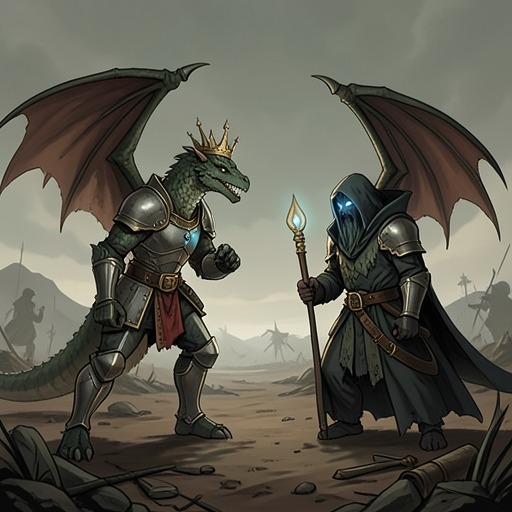
Vainqueur the DragonThe Victor–Furibon relationship is defined by captivity, mutual contempt, and an unstable dependence that neither side can escape. Furibon’s soul is bound to Victor’s scythe, making the weapon both a prison and the material basis of their continuing dialogue. Victor uses that confinement to control an enemy who remains powerful through his knowledge of necromancy, phylacteries, and magic, while Furibon repeatedly reminds him that imprisonment has not erased his hostility or his capacity to threaten the living.
The Scythe as Prison and Point of Contact
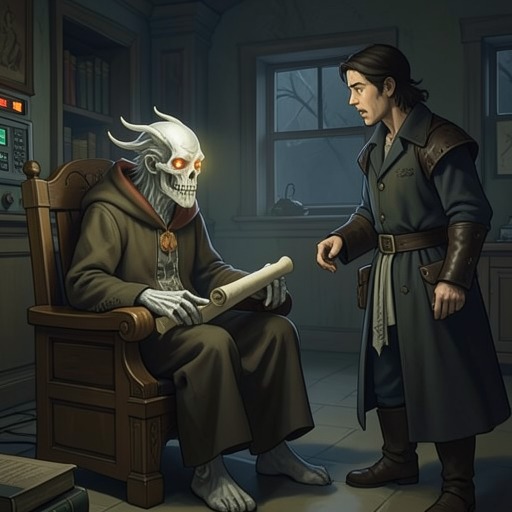
Furibon’s existence within the scythe transforms an ordinary weapon into a contested relationship-space. Victor can address the lich directly, and Furibon can answer from the blade’s edge through a ghastly manifestation of his face. The arrangement gives Victor access to a captive adviser but denies Furibon the independence he once possessed. Their communication is therefore never neutral: every exchange is also a negotiation over control, punishment, and the possibility of further violence.
The binding is especially significant because Furibon’s soul is not simply silenced. He remains conscious, articulate, and capable of hatred. When Victor seeks information about the Apple of Knowledge, Furibon refuses because he hates Victor and everything Vainqueur stands for, even wishing death upon them. The scythe thus preserves the lich as an active antagonist rather than reducing him to an inert magical component; his confinement keeps the conflict present in every later use of the weapon.
Victor’s Coercive Leverage
Victor’s authority over Furibon depends less on physical strength than on his ability to threaten the lich with a fate Furibon finds intolerable. Victor warns that he may surrender the scythe to Vainqueur, condemning Furibon to spend eternity as part of Vainqueur’s hoard. The proposed punishment is not merely continued imprisonment. It would force Furibon to witness Vainqueur showering in gold and producing endless nonsense until the lich loses his mind, turning the dragon’s hoard into an imagined extension of the scythe’s prison.
Furibon reacts to this threat with horror and calls Victor a monster. The accusation reverses the expected moral arrangement: Victor appears weak and innocent, yet his willingness to exploit Furibon’s fear makes him more frightening to the captive than a straightforward executioner would be. Victor accepts the role without hesitation. His power lies in understanding exactly what Furibon fears and converting that knowledge into compliance, demonstrating that the relationship is governed by psychological domination as much as by magical confinement.
Knowledge, Threat, and Reluctant Cooperation
Furibon remains useful because his expertise survives his defeat. When Victor asks about the phylactery, Furibon explains that he moved it to a hidden crypt on another continent after the dragon threatened to destroy his castle. He also promises to return and unleash spell after spell against his enemies. The information reveals both the practical problem of destroying the lich and the continuing danger posed by his soul’s refuge: destroying the current body would not end Furibon if his phylactery remained intact.
Victor understands the mechanism and recognizes that Furibon’s soul returns to its phylactery when his body is destroyed, allowing him to create another body. This knowledge makes Furibon simultaneously vulnerable and difficult to eliminate. Victor can torment or threaten the soul in the scythe, but permanent victory requires locating the hidden phylactery. Their relationship consequently binds Victor to the enemy he wants to defeat: Furibon is a captive, yet he is also the keeper of information needed to understand the terms of his own destruction.
The same pattern reappears when Murmurin faces the prospect of war. After Vainqueur nearly dies and Brandon Maure remains alive with a functioning magitech plane, Victor prepares to defend his charges and anticipates an attack on the region. Furibon taunts him that no one can save him, that the inability to take levels without Crests has left them doomed, and that all of them will soon die. Victor refuses to treat the taunt as a final verdict. Instead, he identifies a use for the captive lich: Victor can learn Necromancy spells, while Vainqueur can learn Exorcisms, and Furibon, as an archmage, must know many such spells.
Furibon rejects the request, refusing to teach magic to Victor or Vainqueur. Victor responds by shaking the scythe so that Furibon’s soul strikes the weapon’s limits, escalating the coercion until the lich agrees to teach Victor. Even then, Furibon narrows the concession: he knows no Exorcisms and does not want to be near Vainqueur. The exchange captures the relationship’s central contradiction. Cooperation is possible, but never through trust or reconciliation; it is extracted from an enemy who continues to resist in every way still available to him.
Hostility Under Pressure
Furibon’s cruelty is most visible when Victor is physically endangered. After Melodieuse’s red lightning strikes Victor and his mount, the mount is felled, Victor is thrown onto the dirt, and the scythe slips from his grasp. Victor reaches critical health while a fairy hound prepares to devour him and a shadowy giant bird descends toward him. From inside the weapon, Furibon cackles and asks whether Victor’s luck will finally run out.
The scene clarifies that captivity has not produced gratitude or solidarity. Furibon does not interpret Victor’s vulnerability as a reason to help; he experiences it as an opportunity to savor a possible reversal of power. Yet his mockery also exposes the limits of his position. He can observe the danger and comment on it, but he remains enclosed within the weapon and cannot freely intervene. The scythe therefore stages a cruel asymmetry: Furibon possesses awareness without liberty, while Victor possesses liberty despite relying on the hostile soul trapped in his weapon.
Narrative Function and Significance
The Victor–Furibon relationship turns the familiar victor-and-vanquished arrangement into an ongoing struggle rather than a completed defeat. Furibon’s defeat does not remove him from the story; it relocates him into an object Victor carries, where every battle, question, and threat renews the conflict. The weapon becomes a portable dungeon, an archive of forbidden expertise, and a recurring reminder that victory over an enemy does not necessarily end the enemy’s influence.
Their exchanges also make knowledge a form of power. Furibon controls information about the Apple of Knowledge, his phylactery, and advanced magic, but Victor controls the conditions under which Furibon can continue existing as an independent agent. Each therefore possesses something the other needs: Furibon has expertise and concealed resources, while Victor has the scythe and the power to determine whether Furibon remains an isolated captive or becomes part of Vainqueur’s hoard. The relationship never resolves into friendship. Its defining achievement is more unsettling: Victor learns to make an enemy useful without ceasing to regard him as an enemy, while Furibon remains dangerous precisely because captivity has preserved his mind, his resentment, and his knowledge.